
Customer Reviews: The Real Engine Behind Discoverability and Trust
Most authors celebrate launch day.
Smart authors celebrate review momentum.
Because while launch spikes create excitement, reviews create sustainability.
If editorial reviews build perception, customer reviews build movement.
They influence algorithms.
They influence buyers.
They influence long-term visibility.
And unlike most promotion tactics, they compound.
Let’s break down why customer reviews are not vanity metrics; they are infrastructure.
Why Reviews Matter More Than You Think
When a reader lands on your book page, they do not start by reading your description.
They scan. They look at:
The star rating
The number of reviews
The tone of recent feedback
Before they trust your words, they trust other readers.
This is not accidental. It’s behavioral psychology.
Humans look for social proof before making decisions. Especially when uncertainty is involved.
And buying a book from someone they’ve never met? That’s uncertainty.
Reviews reduce that uncertainty.
Reviews Influence Two Critical Systems
Customer reviews affect:
Human decision-making
Platform algorithms
Most authors focus only on the first.
But the second is equally important.
1. Reviews and Buyer Psychology
A book with 5 reviews feels risky.
A book with 150 thoughtful reviews feels established.
A book with consistent, recent reviews feels active.
Buyers interpret review volume as:
Popularity
Credibility
Safety
Even if subconsciously.
A reader may not articulate it, but they feel it.
More reviews lower purchase hesitation.
Lower hesitation increases conversion.
2. Reviews and Amazon’s Algorithm
Amazon’s algorithm tracks:
Sales velocity
Page activity
Review activity
Engagement signals
Reviews are activity signals.
Consistent review growth tells the algorithm: “This book is alive.”
Dead books don’t get reviewed.
Active books do.
And Amazon rewards activity with visibility.
The Long Game vs. The Launch Spike
Many authors focus on gathering reviews during launch week.
That’s helpful. But it’s not the strategy.
The strategy is sustained review velocity.
Because:
Ten reviews in one week look artificial.
One or two reviews every week looks organic.
Organic growth builds long-term trust… both with readers and with algorithms.
The goal is not a big splash.
The goal is a steady heartbeat.
What Makes a Review Powerful
Not all reviews are equal. A powerful review includes:
Specific insights
Emotional reaction
Personal takeaway
Practical application
“Great book!” does little.
“This book helped me clarify my business positioning in two chapters” converts.
Specificity creates relatability.
Relatability creates conversion.
Encouraging thoughtful, honest feedback is far more powerful than chasing five-star volume.
The Myth of Controlling Reviews
Some authors try to “manage” reviews.That’s a mistake.
Authenticity matters.
Readers can sense manufactured praise.
A few balanced reviews with constructive critique often increase trust more than a flawless five-star wall.
Because perfection feels artificial.
Honesty feels human.
Trust grows from honesty.
Reviews as Market Feedback
Beyond sales and algorithms, reviews provide something even more valuable:
Market intelligence.
Your reviews reveal:
What resonates most
Which chapters hit hardest
Where readers feel transformation
What language do they use to describe your value
That language becomes marketing copy.
That insight becomes positioning clarity.
Reviews are not just social proof.
They are audience research.
Reviews and Authority Positioning
If you are an expert, coach, consultant, or thought leader, reviews serve a deeper function.
They show transformation.
And transformation builds authority.
When potential clients see: “This book changed how I think about leadership.”
Or: “I implemented this framework and saw results immediately.”
They don’t just see a book. They see capability.
That perception influences consulting inquiries, speaking invitations, and partnership discussions.
Your book becomes evidence.
Reviews validate that evidence.
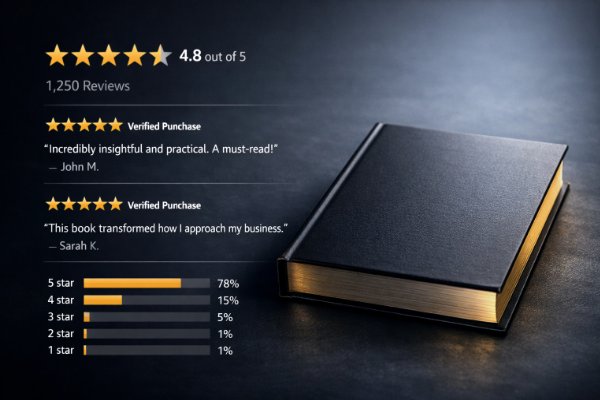
The Momentum Principle
Here’s something many authors miss: Reviews create momentum loops.
More reviews → Higher conversion
Higher conversion → More sales
More sales → More reviews
It’s cyclical.
But cycles require ignition.
Without early review traction, books stall.
Without sustained review growth, books fade.
Momentum must be nurtured intentionally.
The Timing Factor
The timing of reviews matters.
Strategic moments include:
Launch week
Promotional campaigns
Media features
Award nominations
Price promotions
Each spike in visibility should be followed by review reinforcement.
Visibility without review capture wastes opportunity.
Why Some Books Plateau
Books often plateau because review growth stops.
When review activity flattens:
Conversion slows
Algorithm visibility decreases
Organic discovery weakens
It’s not always about poor marketing.
It’s often about stalled social proof.
Reviving review momentum often revives ranking.
Ethical and Sustainable Approach
There is only one sustainable strategy for reviews: Encourage honest feedback from real readers.
That’s it.
No manipulation.
No artificial inflation.
No shortcuts.
Long-term authority requires a clean strategy.
And clean strategy compounds.
Reviews and the Bigger Ecosystem
Customer reviews support:
Amazon ad performance
Award applications
Editorial credibility
Media pitches
Speaking positioning
They are not isolated.
They reinforce every other promotion pillar.
That’s why the review strategy should never be random.
It should be ecosystem-aligned.
The Real Objective
The objective is not to chase five stars.
The objective is to reduce friction.
When a reader feels: “Others like me benefited from this.”
The purchase becomes easier.
When a potential client sees: “This book clearly creates results.”
Hiring becomes easier.
Reviews reduce resistance.
Reduced resistance increases growth.
Final Thought
Customer reviews are not decoration.
They are conversion fuel.
They are algorithm signals.
They are trust accelerators.
And in a marketplace built on uncertainty, trust wins.
Not once.
But over time.